The numbers EHS leaders in the US are working with
The Bureau of Labor Statistics recorded 5,283 fatal work injuries in the United States in 2023, a fatal injury rate of 3.5 per 100,000 full-time equivalent workers.1 Transportation incidents accounted for 36.8% of those fatalities, or 1,942 deaths in a single year. Transportation and material moving occupations alone recorded 1,495 fatalities at a rate of 13.6 per 100,000 full-time equivalent workers, well above the overall average.2
The 2023 total was 3.7% lower than 2022, which is good news. The underlying mix is not. Vehicle and material handling movement on industrial sites continues to be the single largest category of how American workers are killed at work, and it has been for years.
What the OSHA Top 10 keeps telling us
Each year OSHA publishes the standards it cites most frequently after inspections. The FY 2025 list, covering October 2024 through September 2025, kept a familiar shape at the top:3
- •#1 Fall Protection – General Requirements (29 CFR 1926.501) – cited in roughly 5,914 to 6,992 inspections, depending on the source; the 15th consecutive year at #1.
- •#2 Hazard Communication (29 CFR 1910.1200).
- •#3 Ladders (29 CFR 1926.1053).
- •#4 Lockout/Tagout (29 CFR 1910.147).
- •#5 Respiratory Protection (29 CFR 1910.134).
- •#8 Powered Industrial Trucks (29 CFR 1910.178) – the standard that governs forklifts and other powered industrial vehicles.
- •#10 Machine Guarding (29 CFR 1910.212).
The Top 10 has a pattern. The hazards being cited are not exotic. They are the same ones training programs have been built around for decades: working at height, powered vehicles, energy isolation, machine guarding. The fact that the same standards keep appearing year after year is the most useful data point in the list. It is telling EHS leaders, plainly, that the existing playbook is not closing the gap on its own.
Forklifts and pedestrians: a US-specific picture
The BLS forklift fact sheet covering 2011 through 2017 recorded 614 worker fatalities involving forklifts and more than 7,000 nonfatal injuries with days away from work, every single year, across the period. 2017 alone saw 74 forklift fatalities and 9,050 nonfatal injuries with a median of 13 days away from work per incident.4
Inside those numbers, the most consistent contributors are:4
- ✓Nonroadway incidents involving the forklift itself (the single largest category in 2017, at 20 deaths).
- ✓Workers struck by powered industrial vehicles in non-transport contexts (13 deaths).
- ✓Struck-by-falling-object events on forklift operations (12 deaths).
- ✓Falls to a lower level from a forklift platform or load (11 deaths).
- ✓Pedestrian-vehicular incidents inside the facility (9 deaths).
Pedestrian-vehicular incidents inside a warehouse or manufacturing facility are a consistent killer. Engineering and administrative controls (segregation, signage, banksmen, training, audible alarms) have been the long-running answer. They reduce risk. They do not, alone, eliminate it.
OSHA is paying closer attention to warehousing
In July 2023 OSHA issued CPL 03-00-026, a National Emphasis Program (NEP) on Warehousing and Distribution Center Operations. The NEP is a three-year program that targets warehouses, distribution centers, mail and postal processing facilities, parcel courier services, and certain high-injury-rate retail establishments. Inspections under it are comprehensive safety inspections, focused on a defined list of hazards:5
- ✓Powered industrial vehicle operations.
- ✓Material handling and storage.
- ✓Walking and working surfaces.
- ✓Means of egress.
- ✓Fire protection.
- ✓Heat and ergonomic hazards.
OSHA cites BLS data showing that injury and illness rates in warehousing establishments are substantially higher than the private industry average, with some warehousing subsectors at more than double the rate.5 The warehousing labor force is now north of 1.9 million workers. The NEP is, in plain terms, the regulator deciding that the existing controls in this sector are not good enough and that more frequent, more targeted enforcement is part of the answer.
Where active vision actually moves the number
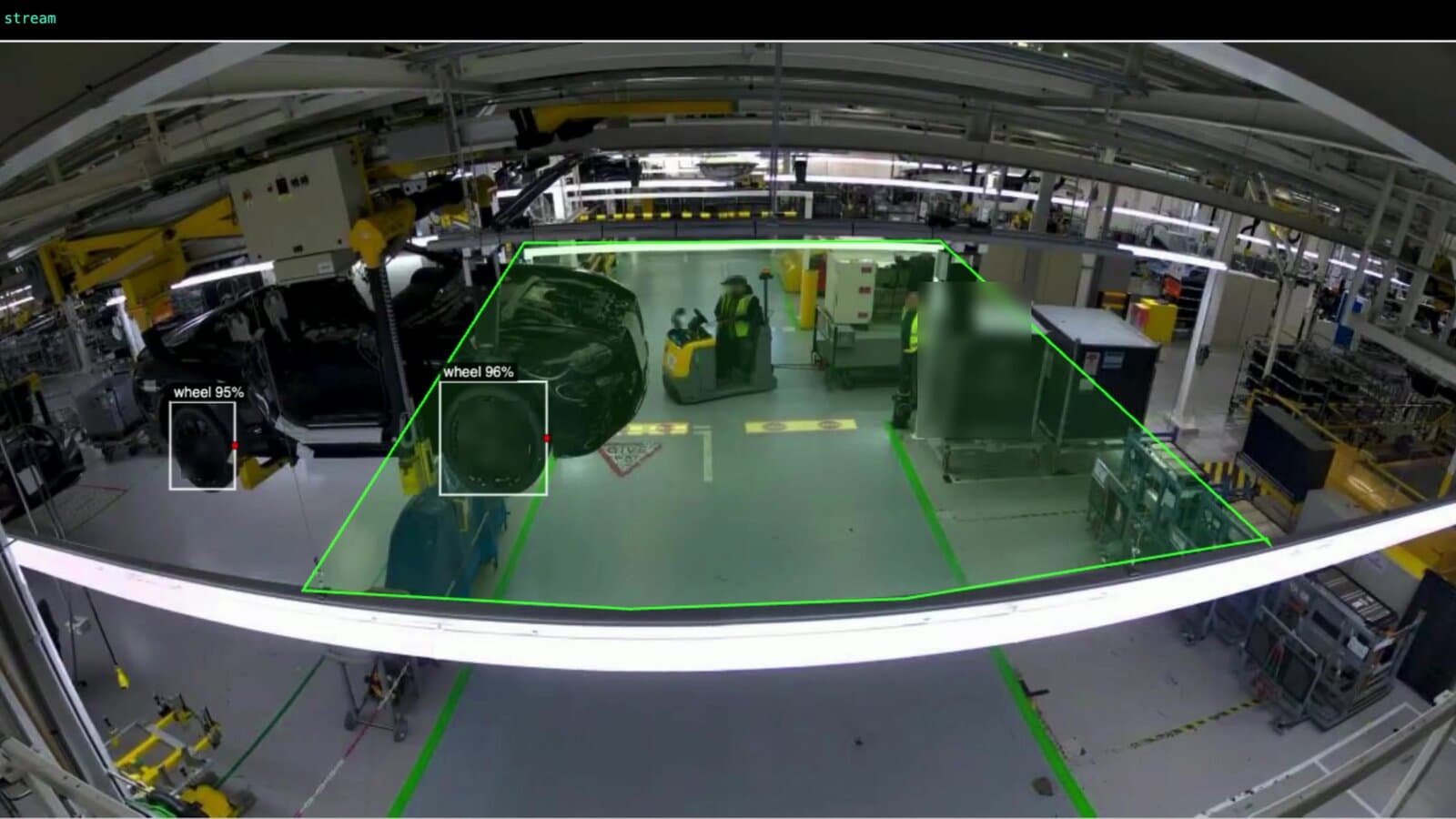
Active vision systems — computer-vision-based detection that drives a deterministic action when a defined hazard condition is present — sit alongside the engineering and administrative controls, not in place of them. The value is specifically in the moments where traditional controls struggle: short reaction windows, constrained sightlines, mixed pedestrian and vehicle traffic, and the human reality that hazards do not announce themselves.
For US warehousing and distribution, the practical use cases that move the OSHA- and BLS-relevant numbers are:
- ✓Pedestrian-in-aisle detection at the moment a forklift or pallet jack enters the same zone, with the action being a projected stop signal, an audible alert, or a deterministic interlock into the existing safety control system.
- ✓Loading-bay control: detecting whether a worker is in the dock area when a vehicle approaches, and holding traffic until the area is clear.
- ✓Exclusion-zone enforcement around presses, conveyors, automated material-handling equipment, and other machinery covered by 29 CFR 1910.212.
- ✓PPE compliance prompts (hi-vis, hard hat, hearing protection, eye protection) at zone entry, with logged evidence rather than continuous surveillance.
- ✓Yard movement: cross-traffic and reversing-vehicle alerts in the yard apron, where many forklift fatalities and severe injuries actually occur.
Each of these is engineered to reinforce an existing control, not to replace it. The signage, training and policy do not go away. What changes is that the moment a hazard becomes real, the system reacts inside a tight latency budget and triggers an action on the floor.
The commercial argument US procurement teams care about
In the US, the regulatory case for active safety lands. The insurance case often lands faster. Workers’ compensation premiums and excess workers’ comp markets price measurable risk-reduction technology directly. A documented reduction in pedestrian-vehicle incidents, combined with auditable evidence that the controls are operating as designed, is information underwriters can act on at renewal.
For sites operating under OSHA’s Warehousing NEP, the same evidence base supports the inspection conversation. The question after an incident, or during a comprehensive inspection, is increasingly: what controls did you have in place to prevent this, and how do you know they were working? An active vision system that records its decisions provides a structured answer.
What to ask any vision-AI safety vendor
Not every product marketed as “AI safety” is built to deliver in a live US warehousing or manufacturing environment. The useful questions are concrete:
- ✓Latency: what is the measured detection-to-action time end-to-end, and how is it verified per deployment? If the answer is “real-time” without a number, that is the answer.
- ✓Edge vs. cloud: does the system run locally on the site, or does detection depend on a network round-trip to a cloud service? Connectivity is not a US warehousing constant.
- ✓Action vs. alert: does the system drive a deterministic action through an interlock, a projected sign, or an existing safety control system? Or does it only raise alerts on a dashboard?
- ✓Integration with existing controls: is it engineered to reinforce the safety controls already on site, or is it a parallel monitoring system on top of them?
- ✓Data minimization: how is video imagery handled? Is anything retained beyond what is needed for audit? Privacy expectations vary by state and by employer policy.
- ✓Continuous measurement: how is post-deployment performance verified over time, and what happens when the model drifts or the site changes?
These are the same questions a serious EHS team would ask of any safety control, not just an AI one.
Where SAiFI fits
SAiFI Edge Essential is an on-site, edge-compute active safety system. Inference runs on the on-site edge device. Detection-to-action latency is engineered and measured to sit under 150 milliseconds. The system integrates with the safety control infrastructure already on the floor and triggers deterministic actions where needed (signs, beacons, gates, sirens, interlocks). It is designed to operate independently of network connectivity. Supported detection domains cover the most common pedestrian-vehicle and PPE compliance use cases in US warehousing and manufacturing, with the catalogue expanding over time.
We are now actively engaging US distributors and end customers in manufacturing, logistics and warehousing. If you are an EHS leader, operations director or warehouse safety manager scoping where active vision fits in your control hierarchy, we would welcome the conversation. If you are a US safety, automation or machine- vision distributor, the SAiFI Distributor Program is open for applications.
Sources & references
- Census of Fatal Occupational Injuries News Release, 2023 · US Bureau of Labor Statistics · December 19, 20245,283 fatal work injuries in 2023; transportation incidents accounted for 36.8% of fatalities.
- Fatal work injuries fell in 2023 · US Bureau of Labor Statistics – The Economics Daily · 2025Fatality rates and occupational breakdown, including 1,495 fatalities in transportation and material moving occupations at 13.6 per 100,000 FTE.
- Top 10 Most Frequently Cited Standards (FY 2025) · US Occupational Safety and Health AdministrationFall Protection – General Requirements held #1 for the 15th consecutive fiscal year; Powered Industrial Trucks at #8.
- Occupational Injuries, Illnesses, and Fatalities Involving Forklifts · US Bureau of Labor Statistics – Fact Sheet614 forklift-related worker fatalities 2011–2017; ~7,000+ nonfatal injuries with days away from work annually; breakdown of leading event types.
- National Emphasis Program on Warehousing and Distribution Center Operations (CPL 03-00-026) · US Occupational Safety and Health Administration · July 13, 2023Three-year NEP covering warehouses, distribution centers, mail/postal processing, courier services and high-injury-rate retail.