Why the definition matters
“Active safety” gets attached to almost anything with a sensor on it. That is a problem, because the term has a real meaning rooted in the established safety control frameworks. When it is used loosely, it stops being a useful procurement signal and starts being a marketing word. The point of this piece is to put the definition back on the same footing as the rest of the safety profession.
We will work from three reference points: the NIOSH hierarchy of controls (the industry-standard ranking of how risk should be reduced), ISO 12100 (the international standard for risk assessment and reduction in machinery design), and the UK Health and Safety Executive’s ALARP principle (the legal test employers in Great Britain have to satisfy).
Reference point 1: the hierarchy of controls
The hierarchy of controls is the canonical ranking of how to reduce workplace risk, maintained in the United States by NIOSH and used internationally. It lists five control types in order of effectiveness:1
- •Elimination — remove the hazard at source.
- •Substitution — replace the hazard with a less dangerous alternative.
- •Engineering controls — isolate people from the hazard through equipment and infrastructure.
- •Administrative controls — change how people work around the hazard: training, procedures, signage, supervision.
- •Personal Protective Equipment (PPE) — reduce exposure when the hazard is still present.
NIOSH is explicit that elimination, substitution and engineering controls are more effective because they reduce exposure without requiring continuous human attention. Administrative controls and PPE can work, but they depend on people doing the right thing every time, in every shift, every day.1
That hierarchy is where active safety has to be positioned to be honest about what it does.
Reference point 2: ISO 12100
ISO 12100 is the Type-A foundation standard for machinery safety. It defines the structured risk assessment and risk reduction process that other standards (Type-B, Type-C) build on, and it is the standard most industrial-safety controls are eventually traced back to.2
For our purposes, two things from ISO 12100 matter most:
- •Risk is a function of severity of harm and probability of occurrence — and probability depends, in turn, on exposure, the occurrence of the hazardous event, and the possibility of avoiding or limiting harm.
- •Risk reduction follows a defined hierarchy: inherently safe design, safeguarding and complementary protective measures, then information for use. Each step is preferred over the next.
A control that genuinely reduces either the probability of the hazardous event or the likelihood that harm follows the event is doing real risk reduction in the ISO 12100 sense. A control that only informs after the fact is not.
Reference point 3: the ALARP principle
In Great Britain, the legal duty on employers is to reduce risks to a level that is as low as reasonably practicable (ALARP), or equivalently, to do so far as is reasonably practicable (SFAIRP). The Health and Safety Executive is explicit that this involves “weighing a risk against the trouble, time and money needed to control it”.3
The practical consequence is that as new control technologies become demonstrably effective, demonstrably reliable and reasonably affordable, the ALARP threshold moves. What was once not reasonably practicable can become so. Vision-based active safety is exactly the kind of technology that has crossed that line in the last three to five years for many industrial applications, which is why regulators are paying closer attention to it now.
A working definition of active safety
With those three reference points in mind, here is the working definition we use, and which we believe matches the way the term is used by serious practitioners:
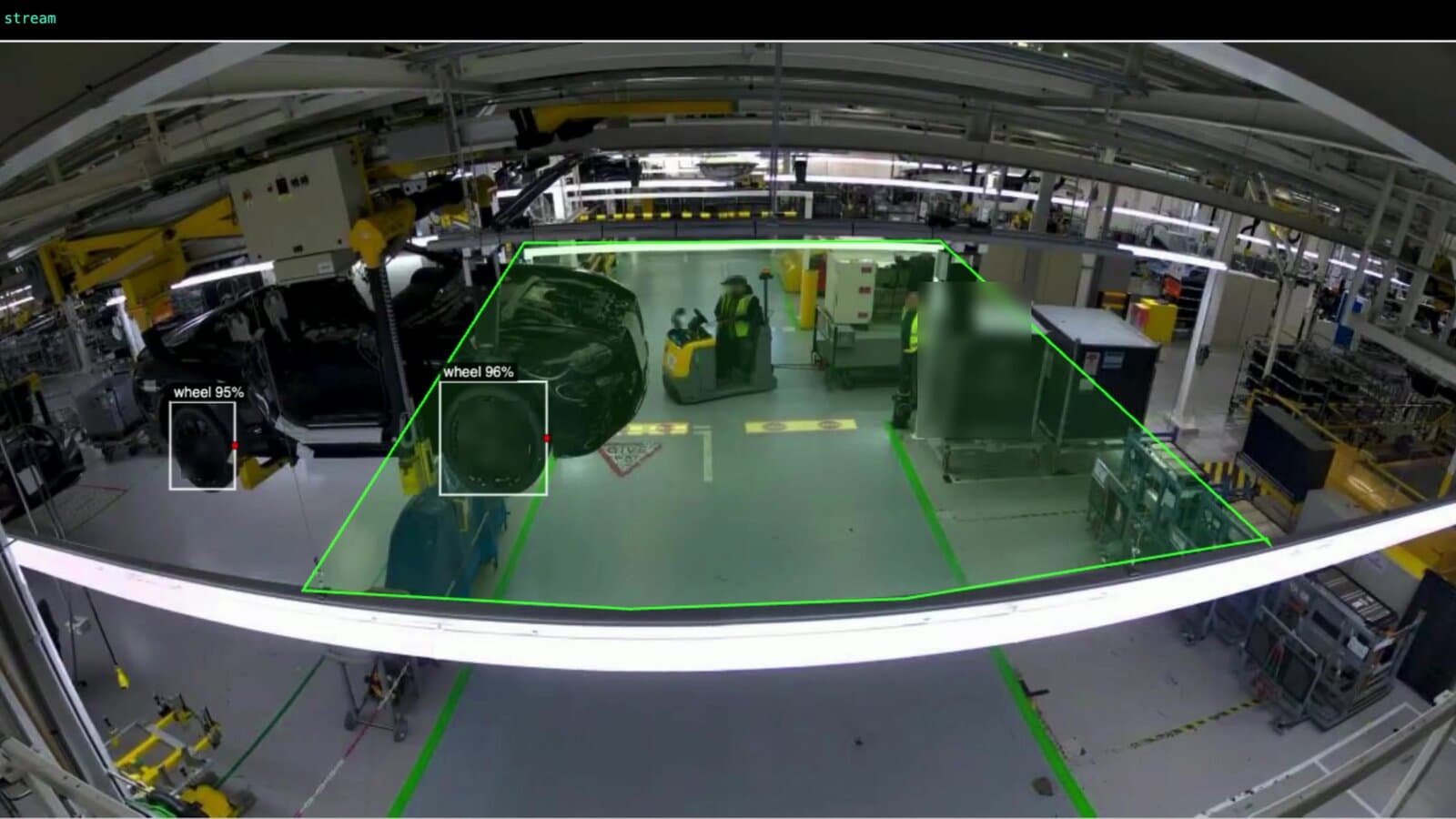
Active safety is an engineering control that detects a defined hazard condition in real time and triggers a deterministic action inside the safety-critical loop, fast enough to change the outcome of the event in progress. It sits in the engineering-controls layer of the hierarchy, alongside guarding and interlocks, not in the administrative or PPE layer.
Three words in that definition are doing a lot of work, and each of them is what separates active safety from other categories that are sometimes called by the same name.
The three words that do the work
- ✓"Detects in real time" — the system perceives the hazard condition as it is happening, not afterwards from a log file, and not minutes later from a dashboard alert.
- ✓"Triggers a deterministic action" — the system itself causes something to change in the physical environment: a barrier closes, a light turns red, an interlock fires, a vehicle stops, an alarm sounds. It does not stop at notifying a human and hoping they react in time.
- ✓"Inside the safety-critical loop" — the action lands fast enough to influence the outcome of the event that is currently happening. For most industrial vision-AI applications, the practical latency budget is well under 150 milliseconds end-to-end. We have written about that threshold in more detail in our earlier piece on 150 ms.
A system that does all three of those things qualifies as an engineering control in the NIOSH sense, contributes to risk reduction in the ISO 12100 sense, and can move the ALARP line in the HSE sense. A system that does only one or two of them is probably useful, but it is something else. Calling it active safety stretches the term to the point where it stops being a useful procurement signal.
What is not active safety (and what it is)
- •Passive safety — guarding, fencing, signage, PPE, lighting. Critical, foundational, and not where active safety competes. Active safety reinforces it.
- •Monitoring or surveillance — cameras that record video and surface alerts to a human operator. Useful for investigation and trend analysis, but the loop is closed by a person, not by the system.
- •Reactive incident management — audible alarms, panic buttons, post-event reporting. Important, but by definition the action follows the harm rather than preventing it.
- •Predictive analytics — dashboards that surface trends across days, weeks or months. Valuable for management and for ALARP arguments, but not in the safety-critical loop of a single event.
- •Driver-assist features (forklift telematics, speed governors) — active in their own narrow domains; not equivalent to a vision-based control that perceives the wider environment around the vehicle.
Each of these has a legitimate place in an industrial safety programme. None of them is a substitute for the others. The cleanest way to think about it is that active safety is one specific layer in a defence-in-depth approach, not a replacement for any of the others.
A short test you can run on any vendor claim
When a supplier says their system is “active”, the useful questions to ask are concrete and bounded:
- ✓What is the measured end-to-end detection-to-action latency, and how is it verified per deployment?
- ✓What physical action does the system drive when it detects the hazard condition? A beacon, a barrier, an interlock into the existing safety system? Or an email and a dashboard tile?
- ✓Where does inference run? On an edge compute device on site, or in a cloud service that depends on a network round-trip?
- ✓How is the system’s ongoing performance measured after install? Is there a periodic verification process, or is the install report the last evidence anyone sees?
- ✓How does the system behave when a sensor or component fails? Does it fail safe, fail loud, or fail silent?
- ✓Where in the hierarchy of controls does the supplier place it, and against which clause of ISO 12100 (or the equivalent national standard) is its risk-reduction claim made?
These are the same questions a competent EHS team would ask of any safety control, not just an AI one. If a supplier cannot answer them with numbers and references, that itself is the answer.
Where SAiFI sits in this definition
The SAiFI Edge Essential system is built to meet this definition. Inference runs on an edge compute device on site. The detection-to-action latency budget is engineered and measured to sit under 150 ms end-to-end. The system drives deterministic actions on real safety infrastructure (lights, signs, gates, sirens, interlocks) rather than stopping at a dashboard alert. It operates independently of network connectivity. And the audit trail of detections and actions is preserved so the ongoing performance can be verified against the original commissioning baseline.
None of that is unique to SAiFI as a category, and the point of this piece is not to argue otherwise. The point is that “active safety” is a useful term when it is used precisely, and a misleading one when it is not. The definition is there to be met.
Sources & references
- Hierarchy of Controls · NIOSH, US Centers for Disease Control and PreventionThe five-level hierarchy (Elimination, Substitution, Engineering, Administrative, PPE) and the rationale for ranking by effectiveness.
- ISO 12100:2010 — Safety of machinery: General principles for design, risk assessment and risk reduction · International Organization for StandardizationType-A foundation standard for machinery safety; defines the risk assessment / risk reduction process referenced above.
- ALARP “At a glance” · UK Health and Safety Executive“Involves weighing a risk against the trouble, time and money needed to control it” — the official HSE description of the ALARP duty.
- Why 150 ms decides whether a safety system is active or advisory · Dynamic SafetyOur companion piece on the latency budget that separates active from advisory.