The brief
A globally recognised luxury automotive manufacturer in Crewe needed to reduce collision risk at a high-frequency crossing point inside a live production facility. Pedestrians, material transfer carts and ride-on pallet trucks move through a height-limited underpass that sits directly beneath an overhead vehicle carrier. When a vehicle is lifted along the carrier and enters the aisle above the underpass, ground-level traffic needs to be held back; with limited sightlines and short reaction times, the risk of a person or truck being underneath at the wrong moment was the issue to solve.
The brief from our distributor partner, WSS Europe, was specific: deliver an active safety layer that reduces collision risk without slowing the operation down, recognises genuine hazard events without firing on normal activity, and integrates within the existing production infrastructure rather than replacing it.
Why traditional detection was not enough
The site had already deployed conventional controls: beam sensors, projected warnings and audible alarms. These provided a baseline warning function but could not interpret what was actually happening in the area. In a live production environment, that distinction matters. The existing system was being triggered by activity that was not genuinely hazardous, and the operational consequences were predictable:
- •False activations whenever movement occurred, regardless of risk.
- •Workflow disruption from unnecessary stops at the crossing.
- •Reduced operator confidence as alerts lost their meaning.
- •A real risk of bypass: when safety systems feel unreliable, they get worked around.
Alternative sensor approaches (radar, LiDAR, more beam coverage) were considered but all shared the same core limitation: they can detect presence or motion, but they cannot understand context. Modifying the vehicle carrier infrastructure would have introduced cost, downtime and production risk for limited safety gain. The conclusion was that the site did not need more detection; it needed smarter decision-making.
What we deployed
Working with WSS, we deployed the SAiFI Edge Essential system as a context-aware active safety layer over the existing crossing. The system runs on-device, on the edge, with all inference happening locally, with no cloud round-trip and no dependency on site connectivity.
- ✓SAiFI Edge Essential system positioned to cover the full crossing zone, with a clear line of sight to the overhead carrier above the underpass.
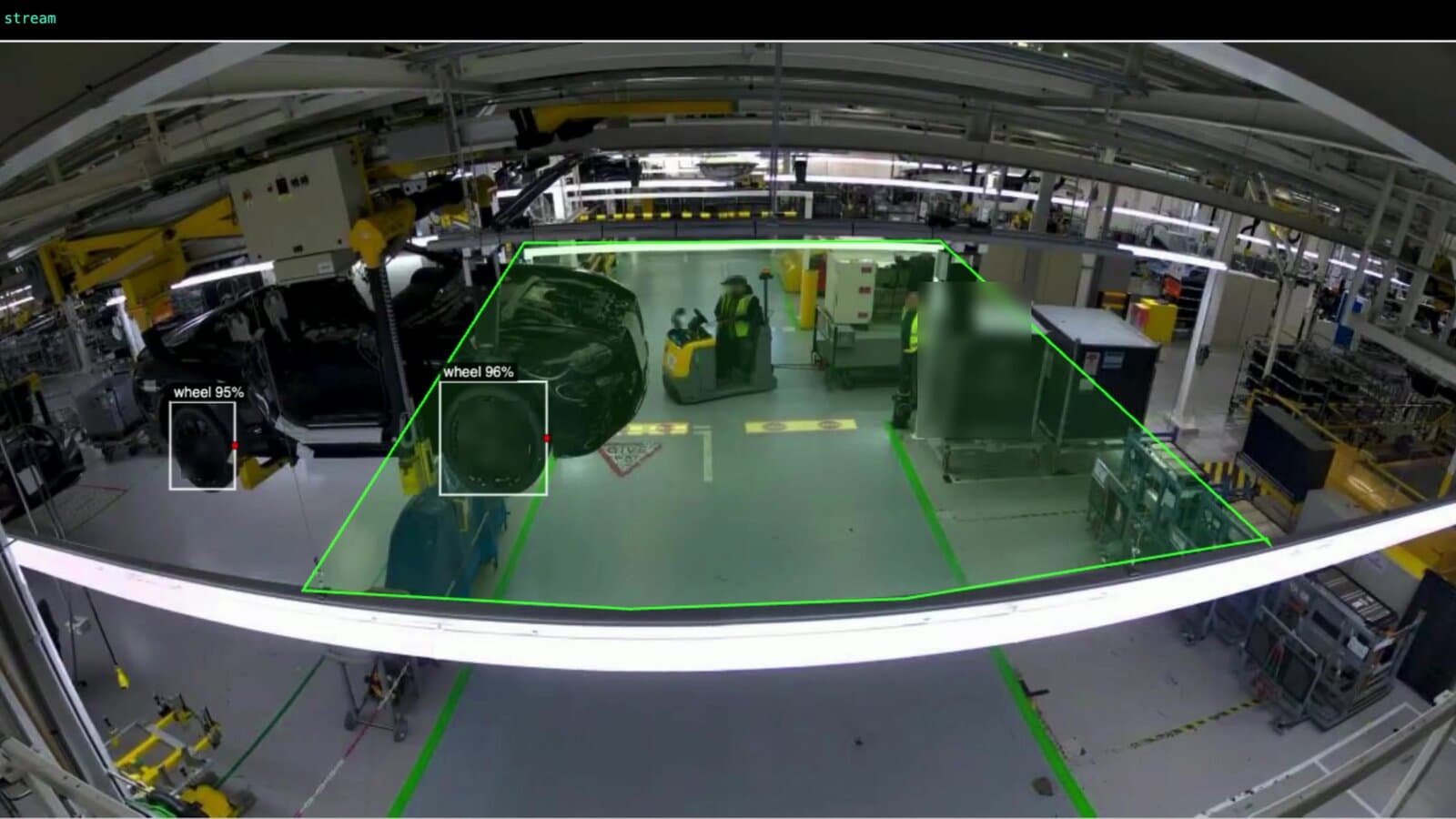
- ✓Site-specific detection trained on the vehicle wheels as they travel along the overhead carrier and enter the aisle above the crossing.
- ✓Zones and rules configured around the underpass, so when wheels enter the aisle overhead the system automatically activates the existing sounders and projected stop signs, holding ground-level traffic until the aisle is clear.
- ✓Direct integration with the existing safety control infrastructure, triggering deterministic actions where needed rather than running as a parallel monitoring system.
- ✓No modifications to the production line or vehicle carrier system: the safety improvement was delivered around the existing operation, not through it.
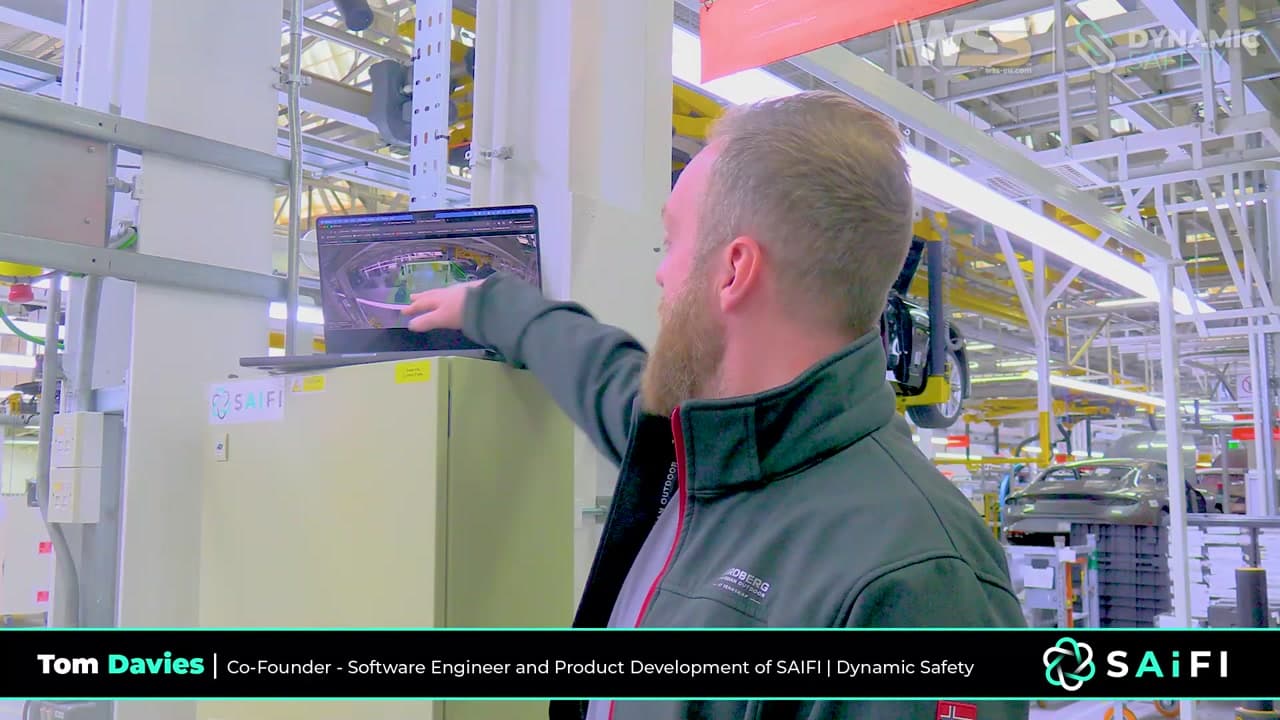
Tom Davies on the deployment site
A short conversation with Tom Davies on the deployment site, talking through what the system is doing in the underpass and why a context-aware approach was the right fit for the environment.
What changed on site
The deployment moved the site from passive detection to context-aware active safety. Rather than reacting to every movement, the system assesses whether a real hazard exists and activates the appropriate response only when it does.
- ✓Over 50 potential vehicle-to-person hazard interactions removed every operational week at the crossing.
- ✓More reliable hazard detection, with the system responding to real risk conditions rather than ambient movement.
- ✓Higher operator trust in the safety controls, because activations now correspond to genuine risk.
- ✓Smoother flow through the crossing and better production continuity, with fewer unnecessary interruptions.
- ✓No major infrastructure modification: the production line and vehicle carrier system were left untouched.
Why SAiFI was the right fit
A site like this carries a stack of constraints that is unusual but not unique in premium manufacturing. SAiFI Edge Essential meets them directly:
- ✓Deterministic, low-latency behaviour suitable for a production-critical environment.
- ✓Context-aware detection that distinguishes genuine hazards from normal operational activity.
- ✓Integration with existing safety infrastructure, rather than replacement of it.
- ✓Offline-first operation, with inference running on-device so detection and action continue regardless of site connectivity.
- ✓Configurable zones, rules and schedules, so the system can evolve with the site as the layout or operating pattern changes.
Download the full WSS case study
Our distributor partner WSS Europe has published the full case study covering this deployment, the operational context and the measurable results. The PDF is theirs, with their branding, and is available to download below.
WSS & Dynamic Safety: Luxury Automotive Manufacturer Case Study
AI-powered safety transformation at a luxury automotive manufacturing facility in Crewe. Active safety, AI visual recognition, pedestrian and vehicle risk reduction.
PDF · approx 6.7 MB · 8 pages
Considering a similar deployment?
If your site has mixed pedestrian and vehicle traffic, constrained sightlines, and a low tolerance for downtime, we would be glad to talk. A survey and scope conversation is the right starting point.